

Allegretto Wave®
The Allegretto Wave® customizes every LASIK treatment to meet the needs of each individual patient. The Wavefront Optimized treatment considers the unique curvature of each cornea. The system takes into account the spherical distortions that can induce glares and night vision conditions.
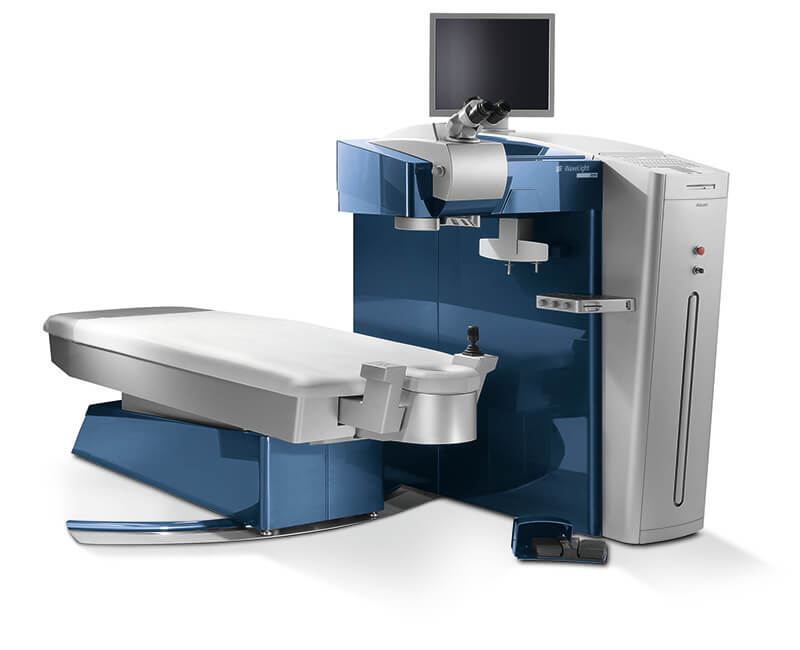
Allegretto Wave uses the innovative Wavefront Optimized technology to automatically compensate for the curvature of the cornea. Lasers in the past, simply focused on correcting the front of the cornea. The results ended up being that the flattened area ended with an edge that caused unwanted side effects like glares, halos and poor night vision.
The Allegretto Wave system changes all of that by sending extra pulses to the peripheral edges of the cornea. The extra pulses allow the cornea to maintain the normal aspherical shape. The Allegretto Wave produces a smooth, effective optical zone that produces high quality vision.
Clinical Results
In 2003, the FDA granted the Allegretto Wave® the widest approval range ever initially given to a new laser for both myopic and hyperopic vision correction. Since then, the results have been astoundingly positive.
- At one year after treatment, more than 93% of patients said they saw at least as well as or better than they had with glasses or contacts before treatment.
- More than 98% of patients achieved 20/40 vision one year after treatment; 20/40 is the level of visual acuity required to pass most driving tests.
- Nearly 60% of near-sighted patients achieved 20/16 vision after one year of treatment.
- Both near- and far-sighted patients reported an improvement in their reaction to bright lights and night driving glare after Allegretto Wave® treatments. In addition, near-sighted patients reported an improvement in sensitivity to light.
- Predictable results are the norm for the Allegretto Wave® . More than 90% of patients achieve refraction within 1 diopter of their target correction.
Is Allegretto Wave® Right for Me?
The Allegretto Wave® expands the boundaries of candidacy for LASIK. In order to truly determine your candidacy to Allegretto Wave you must meet with a doctor. After a thorough evaluation with one of our doctors at Clear Choice Custom LASIK we will evaluate if:
- You are under 21. In this case, your growth phase may not have been fully completed, meaning that your eyes can still change.
- You are pregnant or nursing. Pregnancy causes changes to your hormonal system. This can also cause your vision to change. It is therefore better to wait until your child is born and you have finished nursing.
- You have poorly-controlled glaucoma or blood pressure.
- You have keratoconus, a corneal irregularity.
- You have inflammation of the eye (uveitis, blepharitis or iritis).
- Your eyes have been infected by herpes simplex.
- You have suffered previous severe injuries on the eye.
- You have corneal scars or infections.
- You are taking certain medications.
- You suffer from other diseases of the eye such as AMD, diabetic retinopathy, cataract, or others.
The VisuMax® Femtosecond Laser
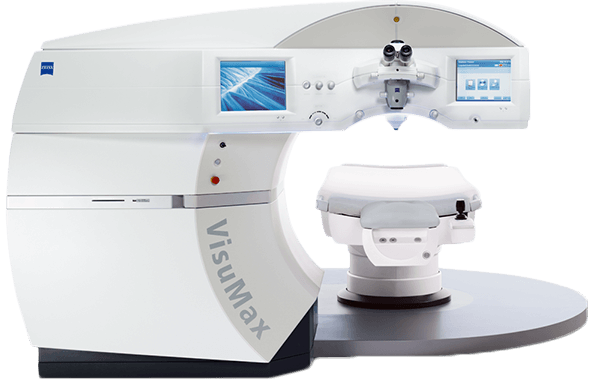
“The VisuMax® Femtosecond Laser Its remarkable features are its precision and innovative detail. With the VisuMax®, Zeiss is significantly shaping the world of refractive surgery. This groundbreaking laser system employs high-performance femtosecond laser technology and is characterized by its outstanding cutting precision, highly efficient speed and gentle treatment technique”.
The accuracy and predictability of the VisuMax® laser have allowed some patients who were previously ineligible for LASIK to now have the procedure. With the femtosecond laser, unlike with mechanical instruments, your surgeon is able to precisely program the dimensions of your flap (diameter and thickness) based on what’s best for your eye.
The Clear Choice Laser Center suggests you visit the FDA’s LASIK Page to ensure you have a clear understanding of the potential risks involved before you elect LASIK treatment. The best way to compare the different lasers is to look at the results submitted to the FDA by the laser manufacturers. (www.fda.gov) FDA approval studies are carefully reviewed, unbiased studies which give the consumer an accurate comparative picture of a laser’s performance. You’ll find the FDA’s list of the most common risks associated with LASIK, along with a list of the lasers FDA-approved for LASIK treatment.
Clear Choice Laser proudly provides state-of-the-art LASIK technology to the residents of the Cleveland, Akron, Toledo, Youngstown and Brecksville areas and beyond.